About All Tours From Split ToursPrivate ToursBoat ToursTours from ZadarWaterfalls Tours Directions Hours & Fees Guides
Find Tours 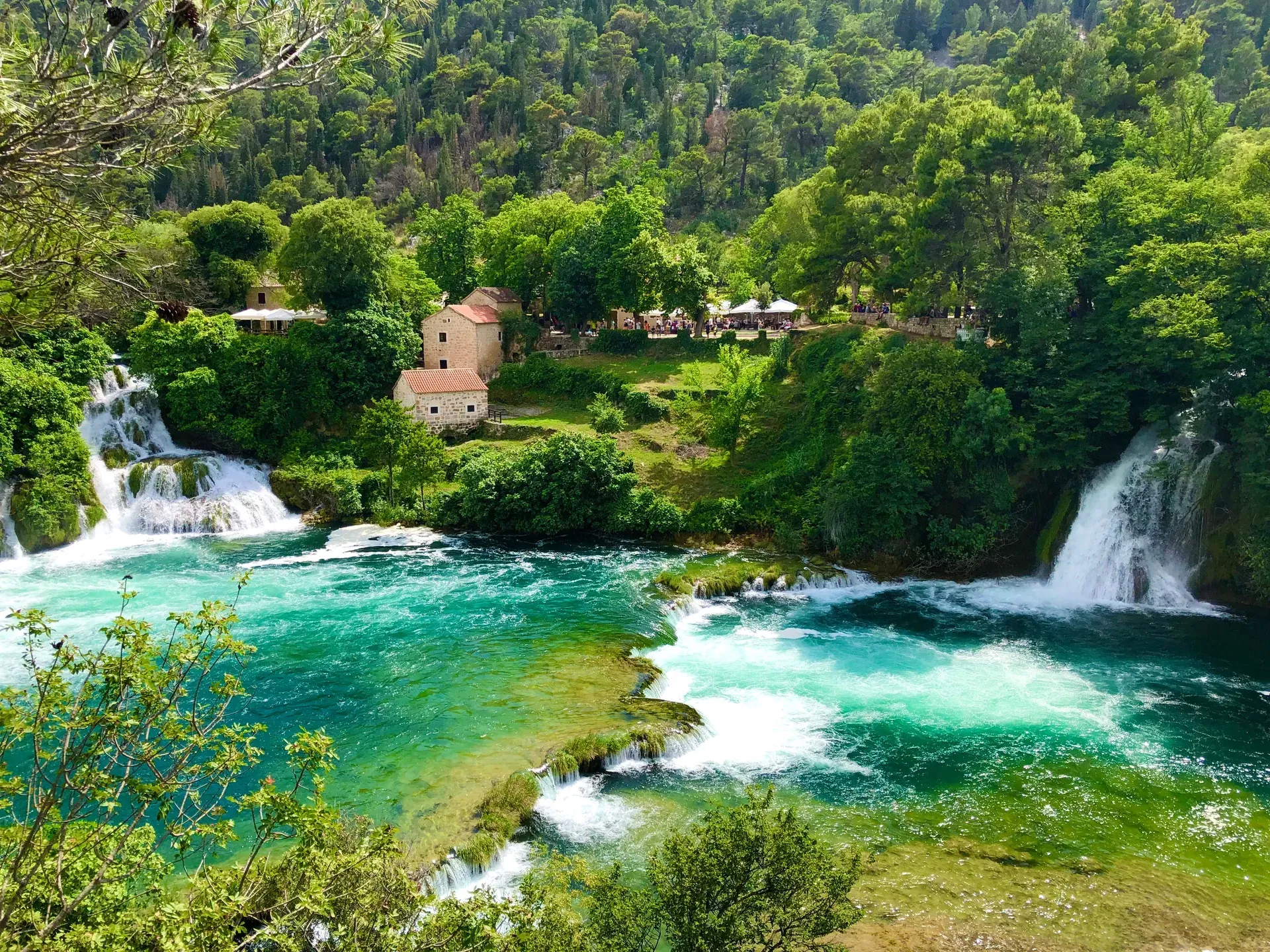
Krka National Park protects 109 km² of the Krka River canyon northeast of Šibenik in central Dalmatia, where seven living travertine waterfalls — including the 45.7-metre Skradinski buk — share the valley with a Franciscan monastery founded in 1445, Roman legionary ruins and the hydroelectric plant that lit Šibenik in 1895.
Skradinski buk drops 45.7 m across 17 travertine steps, and a wooden boardwalk puts you close enough to feel the spray. That single waterfall pulls most of the million-plus visitors who come to Krka National Park each year — Croatia's seventh national park, protecting 109 km² of the middle and lower Krka River plus the lower Čikola, a few kilometres northeast of Šibenik in central Dalmatia.
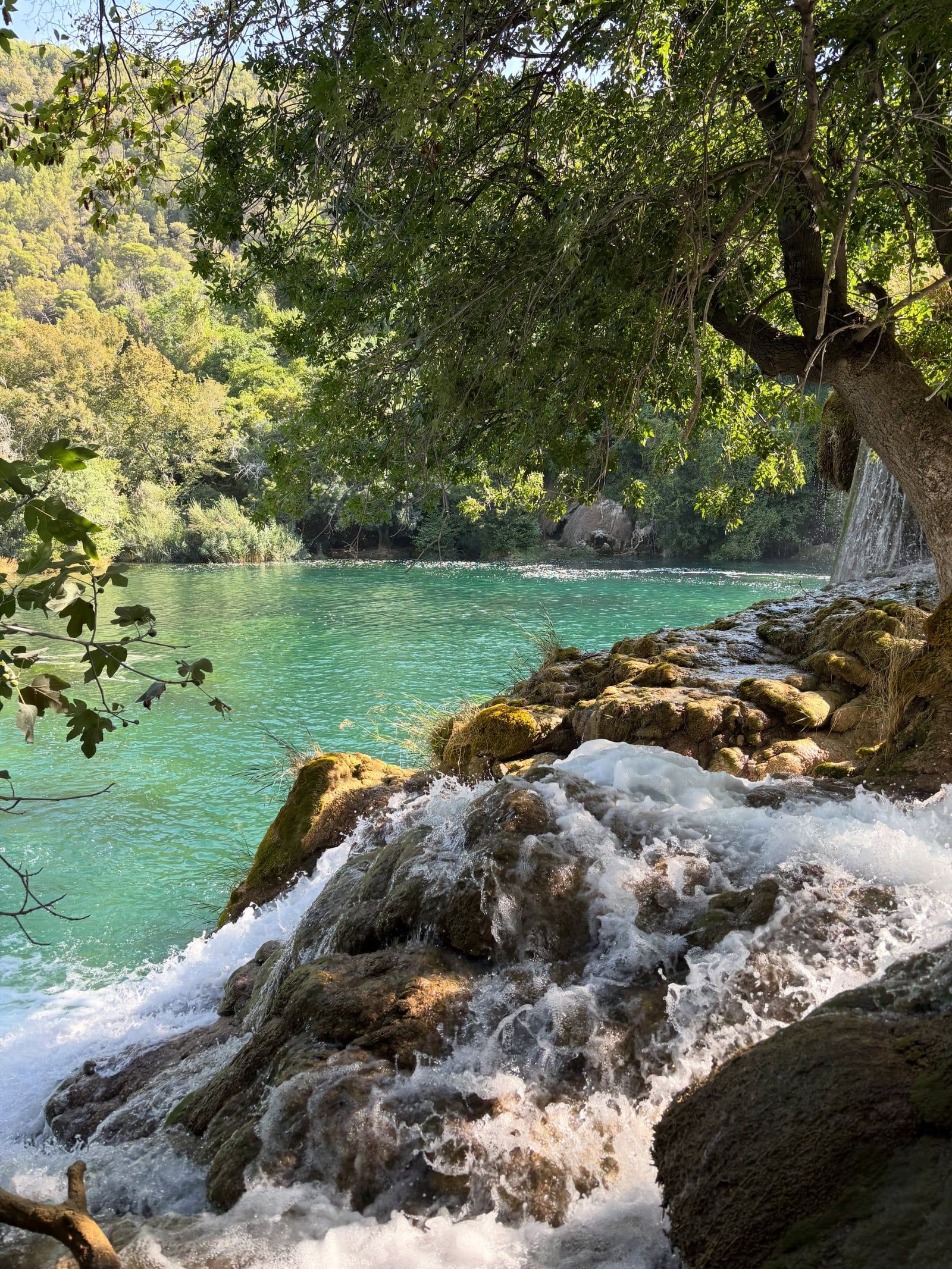
What sets the Krka apart is that it's still building its own waterfalls. The river dissolves calcium carbonate from the limestone it crosses, then deposits that mineral as travertine wherever the current slows over mosses and algae. Layer by layer, the barriers grow — seven of them now, stepping the river down 242 m from Knin to Skradin, inside a canyon cut as deep as 200 m into the karst. This living formation process is internationally rare, and it's the reason the valley received protection in 1985.
Nature shares the park with a dense layer of human history. Franciscans have kept a monastery on Visovac Island since 1445, the Serbian Orthodox Krka Monastery stands in the upper valley, and Roman legionaries garrisoned the camp of Burnum from 42 AD. In 1895 the Jaruga hydroelectric plant made Šibenik the first city in the world lit by alternating-current hydroelectricity. The wildlife counts are just as concrete: 860 plant species, 222 bird species, and 10 fish found nowhere outside this river system. A first visit usually revolves around the Skradinski buk circuit — a 60-to-90-minute boardwalk loop past restored watermills, reached by a 20-minute boat ride up the canyon from Skradin that's included in your ticket. Go in May or September: same waterfalls, half the crowds, €20 instead of €40.
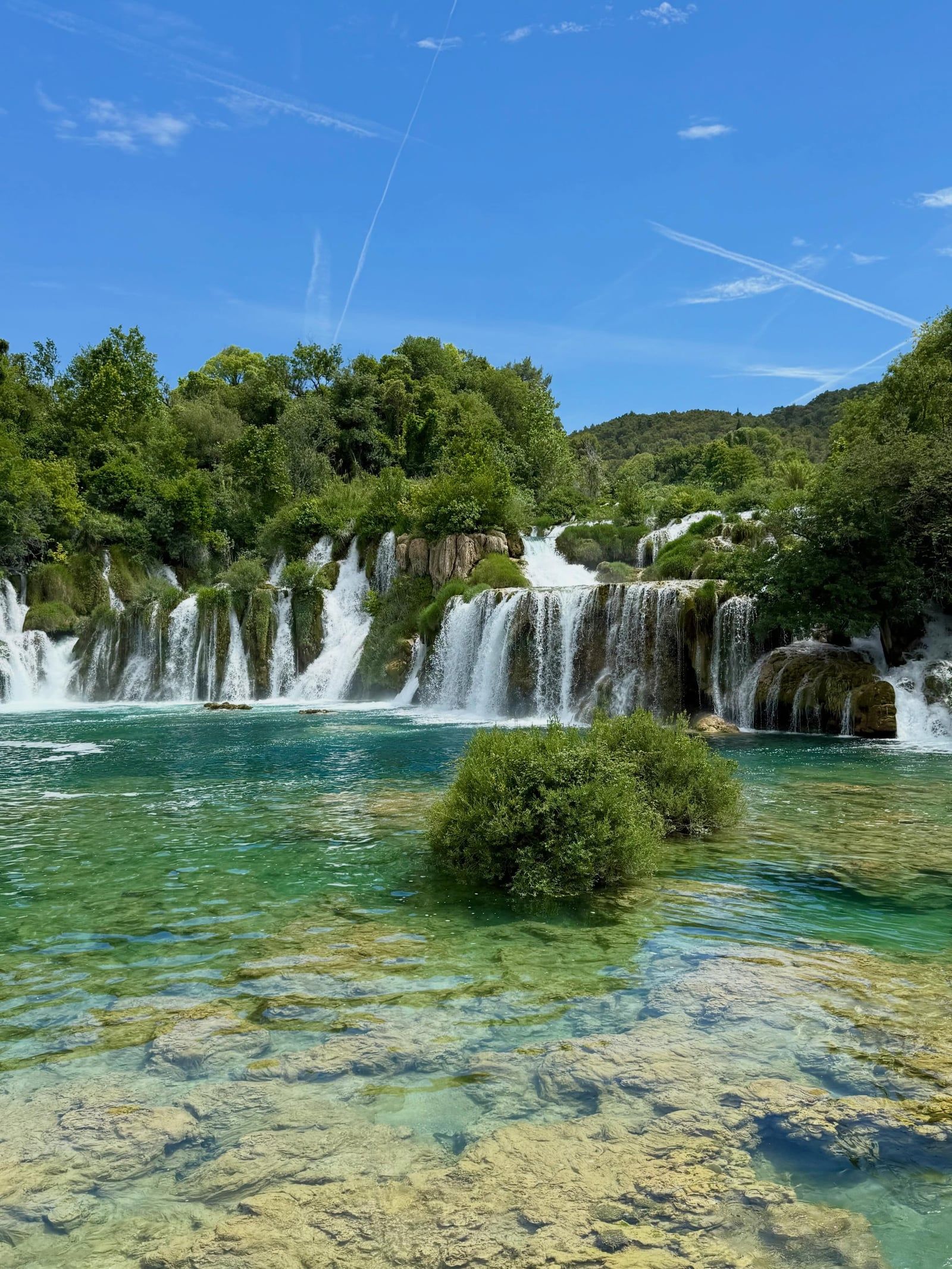
Rain falls on the limestone plateau of central Dalmatia, dissolves calcium carbonate as it sinks underground, and re-emerges loaded with mineral. Where the Krka's water accelerates over mosses and algae, that load drops out as travertine — tufa — in thin, living layers. Each barrier slowly raises the riverbed until the water spills over and begins forming the next one downstream. Seven barriers now step the river down 242 m between Knin and Skradin, and the process is still running. Touch a submerged barrier and you're touching the mechanism itself, which is one reason walking on the tufa is prohibited.
The Romans called the river Titius. At the turn of the era they built the legionary camp of Burnum on a bluff above the canyon near modern Puljane; Legio XI Claudia Pia Fidelis garrisoned it from 42 AD, replaced by Legio IV Flavia Felix from 69 AD. The excavated camp and its command building are visitable today, April through October. Fourteen centuries later, in 1445, Franciscans settled Visovac Island — a few acres of rock in the middle of a broad river lake — and built the monastery that still operates there. The medieval fortresses of Trošenj and Nečven, on opposing canyon rims upstream, belonged to the noble families who once controlled this stretch of water.
On 28 August 1895 the Jaruga hydroelectric plant, just below Skradinski buk, began transmitting power 11 km to Šibenik. It opened two days after the Niagara Falls plant — and it made Šibenik the first city in the world lit by a complete alternating-current hydroelectric system. More plants followed along the river at Miljacka (1907) and Roški slap (1911). The 1895 plant building still stands at the end of the Skradinski buk boardwalk, so you can walk from a waterfall to one of the world's oldest power stations in under ten minutes.
Krka was proclaimed a national park in 1985, the seventh in Croatia, chiefly to protect the living travertine. By 2016 annual visits had passed one million, and the park introduced capacity limits to keep Skradinski buk from being loved to death. On 1 January 2021 swimming was banned across most of the park because foot traffic damages barriers that took centuries to deposit; three designated swim zones remain at Roški slap, Stinice and Pisak, open 1 June to 30 September. Book online and arrive before 9:00 in July and August — once capacity is reached, latecomers wait.
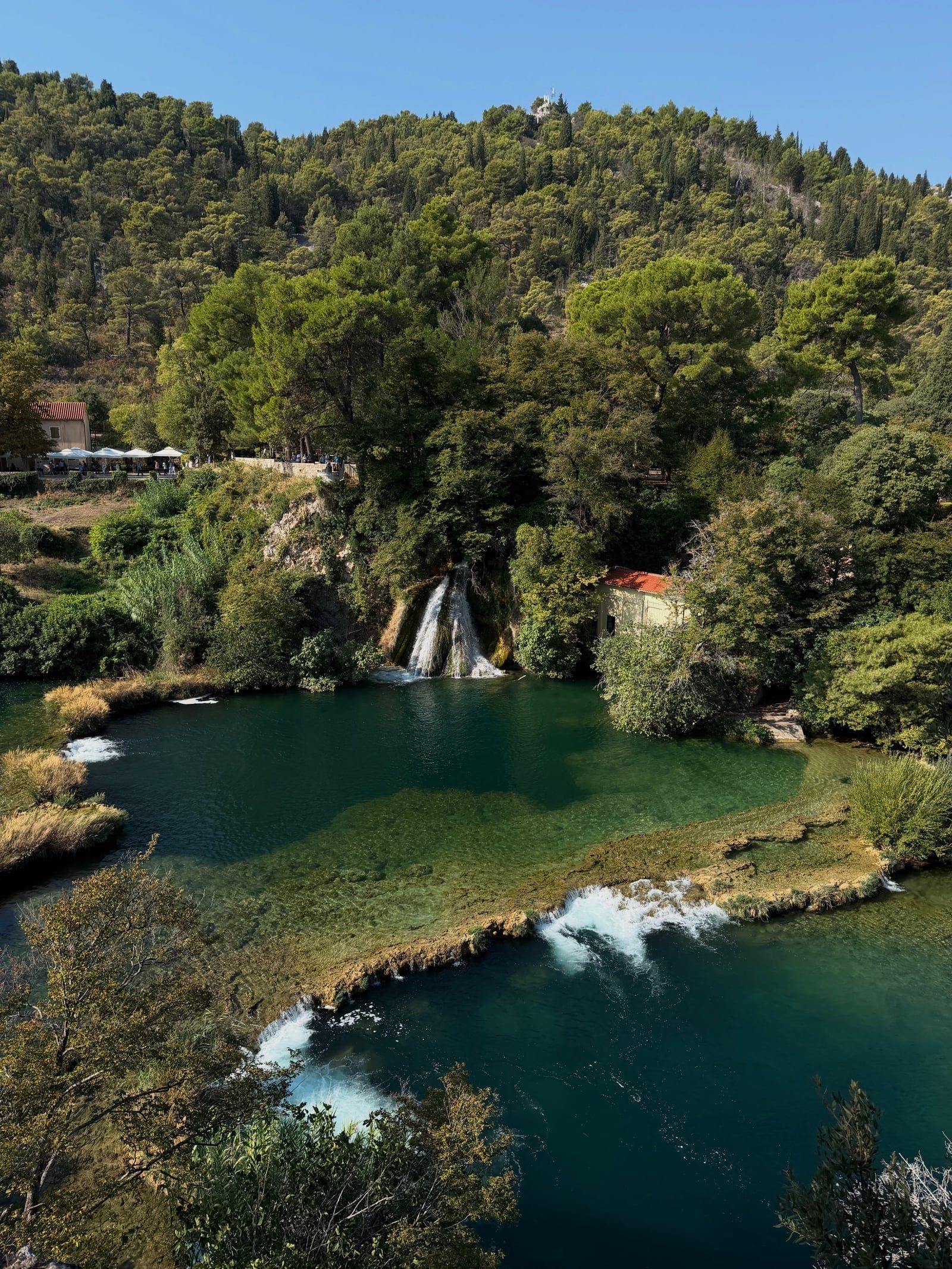
The park's layout is a sequence. The Krka enters near Knin and leaves at Skradin, and in between seven travertine barriers staircase the river down 242 m through a canyon cut as much as 200 m into limestone. Skradinski buk is the giant of the chain: 17 separate cascades strung across 800 m of barrier, 200 to 400 m wide, with 45.7 m of total drop. Wooden walkways thread between the channels and islands, and from their rails you can watch pale mineral crust building on the tufa just below the surface.
Upstream, the character changes. Miljacka falls 23.8 m in a narrower, shadier gorge. Roški slap spreads into a string of low stair-step cascades and tufa islands that locals call the necklaces. Manojlovac, the tallest barrier, sits deep in the upper canyon with restricted hours (10:00–18:00 April–June and September, 8:00–20:00 in July and August, closed in winter). Habitats shift along the river too: tufa lakes and wetlands near the falls give way to rocky garigue and dry-stone-wall fields — with the second-highest lavender density in Europe, so expect bees on every boardwalk.
The species counts back the landscape up: 860 plants, 222 birds (golden eagle, Bonelli's eagle, peregrine falcon) and 18 fish species, 10 of them endemic to this river system. Beyond the falls, 47 km of hiking trails and 388 km of cycle routes reach the quieter upper-park sights, including Oziđana pećina cave and its archaeological display. Bikes rent at the Krka Eco Campus in Puljane from €15 an hour. Wear grippy shoes wherever you go — the walkways stay wet year-round.
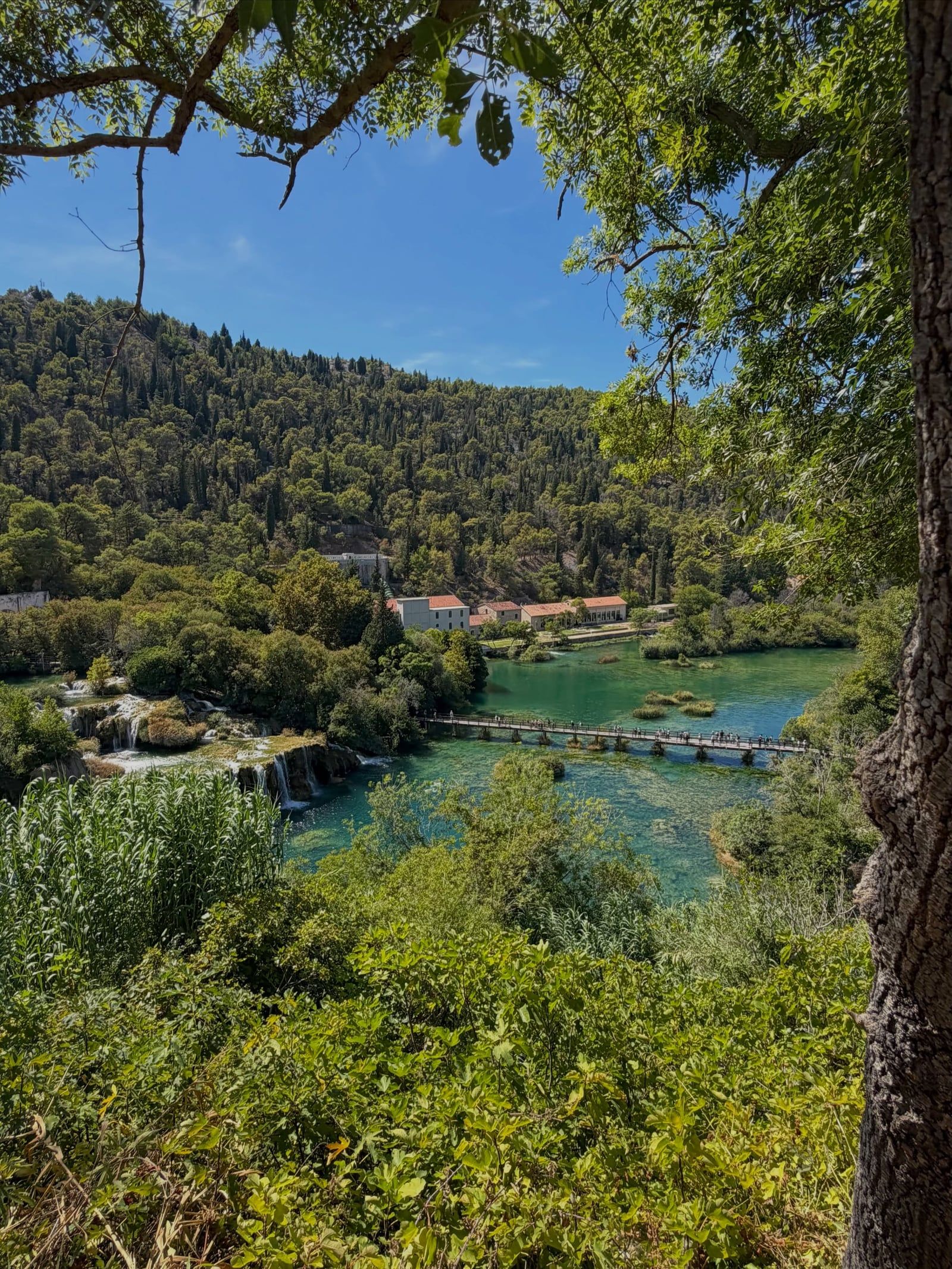
Two monasteries anchor the park's religious life. Visovac, Franciscan since 1445, occupies an island you can walk around in under ten minutes; on 2 August and 15 August it opens solely to pilgrims, when the regular tourist boats stand down. Further upstream, the Serbian Orthodox Krka Monastery holds its own centuries of worship on the canyon's edge — a Catholic and an Orthodox house sharing one river valley, which in this part of the Balkans carries real weight.
Working life along the Krka is preserved alongside the sacred. At Skradinski buk, restored watermills still grind grain, and an ethno-village cluster shows how families lived off the river's power before electricity reached the villages. The park's rules explicitly ask visitors to respect the daily life of residents in Skradin and the surrounding hamlets, and to keep the 'natural silence' — loud music is discouraged on the trails and boats.
For Šibenik, the park is wrapped up in local pride. The 1895 Jaruga plant turned the city into the first in the world lit by alternating-current hydroelectricity, and the plant building still stands at the end of the Skradinski buk trail. A visit to the falls and a walk through Šibenik's UNESCO-listed old town make a natural pairing — the two are twenty minutes apart by car.
The Jaruga plant opened on 28 August 1895, two days after the Niagara Falls plant, transmitting power 11 km to Šibenik — the first city in the world lit by a complete alternating-current hydroelectric system.
Of the 18 fish species recorded in the Krka, 10 are endemic — they exist nowhere outside this river system.
Swimming at Skradinski buk and most of the park has been banned since 1 January 2021, because footsteps damage travertine barriers that took centuries to build. Three designated zones remain open 1 June–30 September.
The park's dry-stone-wall landscapes hold the second-highest lavender density in Europe — which is why bees and wasps are a constant on the boardwalks in bloom season.
The adult ticket drops from €40 in high summer to €7 between November and March, when the falls carry their maximum water and the crowds vanish — though boat transfers stop until 1 April.
The park's official FAQ warns that GPS navigation often routes drivers into fields instead of entrances. Follow the brown tourist signs to Lozovac, Skradin, Laškovica or Puljane.
Unmanned aerial vehicles are prohibited throughout the park, and Croatian aerial-photography violations draw fines of roughly €650–€3,300 per incident, with confiscation possible.
Krka National Park is known for its chain of seven travertine waterfalls, above all Skradinski buk — 17 cascades dropping 45.7 m across an 800-metre barrier — linked by wooden boardwalks. It's also home to the Franciscan monastery on Visovac Island (founded 1445), the Roman camp of Burnum, and the 1895 Jaruga hydroelectric plant that made Šibenik the first city in the world lit by alternating-current hydroelectricity.
The river water carries dissolved calcium carbonate from the limestone it crosses. Where the current slows over mosses and algae, the mineral precipitates out as travertine (tufa), building barriers layer by layer. The process is still active today — each barrier slowly raises the riverbed until the water spills over and starts forming the next one downstream.
Only in three designated areas — Roški slap, Stinice and Pisak (Remetić) — and only from 1 June to 30 September, at your own risk. Swimming at Skradinski buk has been banned since 1 January 2021 to protect the fragile travertine, and jumping off the falls or bridges is prohibited everywhere.
Per the official 2026 price list, adults pay €40 in June–September, €20 in April, May and October, and €7 from November to March. Children 7–18 and students pay €15/€12/€4 for the same seasons, and children under 7 always enter free. Entering after 15:00 in summer cuts the adult price to €30.
Lozovac is the main car entrance, with free parking and a free shuttle bus down to the falls. Skradin is the scenic option — your ticket includes a 20-minute boat cruise up the canyon to Skradinski buk, running 1 April to 31 October. Families with strollers and anyone short on time: Lozovac. Photographers and anyone who likes arriving by water: Skradin.
The Skradinski buk boardwalk circuit takes 2–3 hours with photo stops — the walk itself is 60–90 minutes. Allow half a day including the Skradin boat transfer, and a full day if you add the Visovac excursion (2 h) or the Visovac + Roški slap boat tour (4 h).
Yes, year-round. Skradinski buk is open 9:00–16:00 in January, February, November and December, and the falls carry their maximum water then. But boat transfers stop (they run 1 April–31 October), Manojlovac and Burnum close, and the park shuts entirely on 25–26 December; on 1 January only the Lozovac entrance is open.
Yes, on a leash at all times — but never on Visovac Island. Bring water for them; summer heat on the open boardwalks regularly exceeds 30 °C with little shade.
The single-day ticket includes the boat between Skradin and Skradinski buk and the shuttle bus between Lozovac and the falls (both 1 April–31 October), plus one entry to every open land locality that day. Note each locality can be entered only once on a ticket. Boat excursions to Visovac, Roški slap and the Čikola cost extra, €10–€20 per adult, sold on site only.
Largely, at Skradinski buk: there's a free shuttle from the Lozovac parking area, paved and mostly flat approach roads, and a flat boat landing from Skradin. Some boardwalk sections are narrow with steps, so ask staff at the entrance for the accessible route. Holders of a European Disability Card plus one companion enter free.
Browse verified tours with free cancellation and instant confirmation.
Find Tours